Nusa Penida Weather by Month: An Honest Guide from a Local Operator
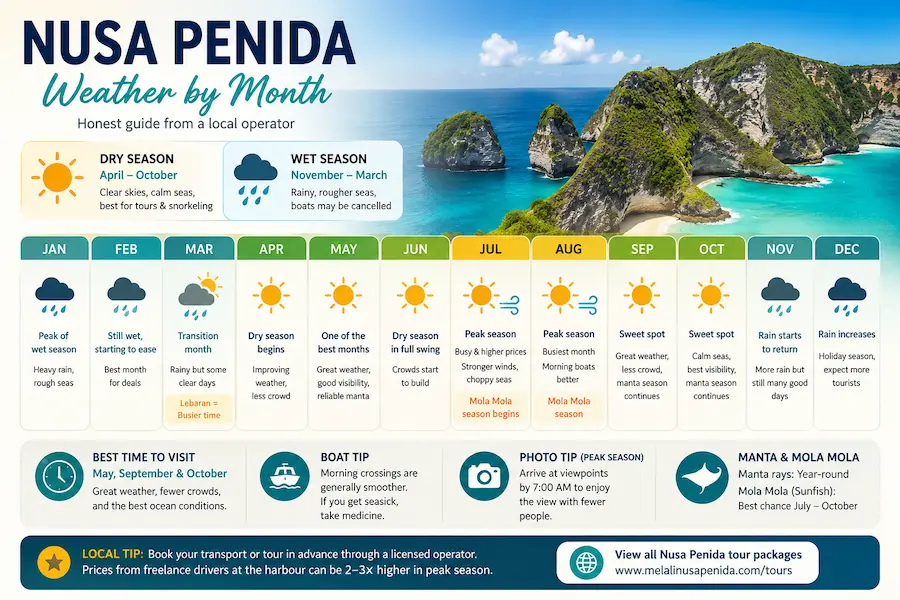
**Excerpt:** Nusa Penida weather is not just dry season versus wet season. Every month tells a different story — from peak chaos in July and August to the island's quietest and most beautiful version in September and October. This is what actually happens on the ground, month by month, from a local operator who runs tours here year-round.
Most weather guides for Nusa Penida tell you the same thing: come April to October, avoid November to March. That is not wrong, but it is incomplete. The reality is more nuanced — and knowing the details can mean the difference between visiting in peak chaos or finding the island at its quietest and most beautiful.
This guide breaks down what actually happens on the island each month, based on years of running tours here.
The Two Seasons — What They Actually Mean
Nusa Penida has two distinct seasons: dry and wet. Unlike Bali's main island, where rain often falls in short afternoon bursts even during dry season, Nusa Penida's dry season is genuinely dry — clear skies, strong sun, and very little rainfall for months at a time.
Dry season: April to October
Clear skies, calm seas, good snorkeling visibility. The fast boat crossing from Sanur is generally smooth in the morning. Roads are dusty but passable. This is when the island looks like the photos you have seen online.
Wet season: November to March
Rain arrives gradually from November, peaks in December and January, and starts easing from February. The crossing from Bali can be rougher, and some days boats are cancelled entirely. Roads get slippery in places. Some activities become harder to plan around.
What the guides do not tell you: wet season has a different kind of beauty. The island cools down significantly — after months of dry heat, the relief is real. The landscape turns intensely green. Bukit Teletubbies, which looks dry and yellowed in peak season, transforms into exactly what its name suggests — rolling, vivid green hills that look almost unreal. If you are chasing that version of Nusa Penida, wet season is the only time you will find it.
Month by Month Breakdown
January
Peak of wet season. The rainiest month of the year — expect heavy afternoon downpours and some full-day rain. The Sanur–Penida crossing can be rough, and BMKG (Indonesia's meteorological agency) occasionally issues advisories that prevent boats from departing entirely. If that happens, all operators cancel — it is a safety call, not a business one.
Good for: Travelers who want the island to themselves and do not mind adjusting plans around weather.
Avoid if: You have a tight schedule or cannot handle uncertainty.
February
Still wet season, but starting to ease. Rain is less consistent than January. Occasional clear days appear.
Good for: Budget travelers — accommodation and tour prices are at their lowest.
March
Transition month. Rain continues but becomes less predictable — some days are fully clear, others wet. Lebaran (Eid al-Fitr) sometimes falls in March depending on the Islamic calendar. During Lebaran, both domestic and international visitor numbers spike significantly. The island has become better at handling this over the years, but expect busier roads and attractions.
April
Dry season begins. This is when conditions start to improve noticeably — skies clear, seas calm, and the crossing from Sanur becomes reliable again. Still relatively quiet compared to peak season.
Sweet spot for: First-time visitors who want good weather without the July–August crowds.
May
One of the best months to visit. Dry season is established, crowds are manageable, and the landscape still has some green from the wet season. Manta ray sightings at Manta Point are reliable.
June
Dry season in full swing. Crowds begin building as European and Australian school holidays approach. Still more comfortable than July–August.
July & August
Peak season. The island is at its busiest — fast boats fill up, viewpoints get crowded, and accommodation prices rise.
The trade-off: July and August are also when trade winds pick up in the Bali–Penida channel. Morning crossings are generally fine, but afternoon crossings can be noticeably choppier. If you are prone to seasickness, take medication before boarding — and aim for morning departures.
Mola Mola season begins in July. The oceanic sunfish come up from the depths when cold water upwellings arrive. Sightings are not guaranteed, but Nusa Penida has some of the most reliable Mola Mola dive sites in the world.
If you are visiting in July or August: be at your first viewpoint by 7 AM. The difference between arriving at Kelingking at 7 AM versus 9 AM is the difference between a quiet clifftop and 200 people taking the same photo.
A note on pricing: Licensed tour operators with official websites keep prices stable year-round — what you see on the site is what you pay, regardless of season. What changes in peak season is the freelance drivers who wait at the harbour. In low season they undercut everyone to get business. In July and August, with boats full and demand high, some of them raise prices by as much as 300% above the normal rate. There is no regulation stopping them. The simplest way to avoid this: book your transport or tour in advance through a licensed operator before you arrive at the harbour.
→ View all Nusa Penida tour packages — fixed pricing year-round
September & October
The sweet spot. Dry season continues, crowds thin out as European and Australian holidays end, and Mola Mola sightings are still reliable through October. Seas are calm and snorkeling visibility is at its best. This is arguably the best window to visit Nusa Penida — good weather, fewer people, and the full range of marine life still present.
Best months overall for: Divers, snorkelers, photographers, and anyone who wants the dry season experience without peak season crowds.
November
Wet season begins. Rain starts arriving — initially light and occasional, becoming more frequent through the month. Crowds drop off quickly. The island starts to green up.
December
Wet season deepens. December and January are the two wettest months. The holiday period (Christmas and New Year) brings a spike in visitors despite the weather — book accommodation and tours in advance if you are visiting in late December.
What About Extreme Waves?
This is something no weather calendar can predict reliably.
Nusa Penida sits in open ocean exposed to the Indian Ocean swell. On most days, the seas are calm enough for tours to run normally. But occasionally — and this can happen in any month, including the dry season — large swells arrive that change everything.
When this happens, Angel's Billabong and Broken Beach transform. The natural infinity pool at Angel's Billabong, normally calm enough to swim in at low tide, becomes a surge zone with waves crashing over the rocks. Broken Beach turns into a dramatic water blow. These are extraordinary to watch — and entirely off-limits to enter.
When conditions are severe enough, BMKG issues a formal advisory and the Syahbandar (harbour authority) in Sanur does not permit boats to depart. This is not a decision operators make — it is a government safety call, and it applies to every operator on every route. When that happens, cancellations happen across the board.
Melali's policy: If your tour is cancelled due to conditions beyond our control, we will offer to reschedule first. If rescheduling does not work for your plans, we provide a full refund.
Kelingking and Wet Season — The Real Story
Most travel sites warn that Kelingking Beach descent becomes "very dangerous" in wet season. The reality is more nuanced.
The descent at Kelingking is carved into limestone — not soil. Limestone does not become as slippery as dirt or clay when wet. The path is still more slippery than in dry conditions, and you should absolutely take extra care — proper footwear, slow pace, use the ropes. But it is not the dramatic hazard some guides suggest. The viewpoint itself is accessible year-round, rain or shine.
Practical Summary by Traveler Type
Best overall months: May, June, September, October — good weather, manageable crowds, full marine life activity.
Best for Mola Mola diving: July to October — cold upwellings bring the sunfish up from depth.
Best for Manta rays: Year-round at Manta Point, most reliable May to October.
Best for photography: September–October for dry season light with thinner crowds. Wet season for green landscapes and the most dramatic version of Bukit Teletubbies.
Best for budget travelers: January–March — lowest prices, fewest tourists, but plan flexibly.
Peak season (book in advance): July–August and late December.
Avoid if you have a fixed itinerary: December–January — cancellations due to weather are most likely during these months.
One Thing Worth Knowing About the Crossing
The fast boat from Sanur takes 35–45 minutes. Morning crossings are generally calmer — the channel between Bali and Nusa Penida tends to roughen in the afternoon, especially in peak season when trade winds pick up. This is not a rule, but it is the pattern.
If you are prone to seasickness, take medication 30 minutes before boarding and choose a morning departure. Sitting at the front of the boat makes motion sickness worse — mid-boat or rear is more stable.
Already Decided When to Visit?
→ View all Nusa Penida tour packages
→ Book a fast boat ticket from Bali
→ Car charter with driver — full day
→ Nusa Penida travel guide — full trip planning
→ Best time to visit Nusa Penida — overview
Related Articles
 Tour Tips
June 28, 2026
Where to Stay in Nusa Penida Choose Your Area Before You Choose Your Hotel
Nusa Penida is not a small island. From the main harbour to Diamond Beach on the east coast takes around 1.5 hours by car — and that single fact changes everything about how you should choose where to stay. This guide breaks down every area of the island honestly, so you can match where you sleep with what you actually want to do.
Read more Travel Guide
June 21, 2026
How to Get from Nusa Lembongan to Nusa Penida (A Local's Honest Guide)
Staying on Nusa Lembongan? You can reach Nusa Penida directly without going back to Bali. Here's how the boat crossing works, the one ticket mistake that costs you an hour of waiting, and why starting from Lembongan beats starting from Sanur.
Read more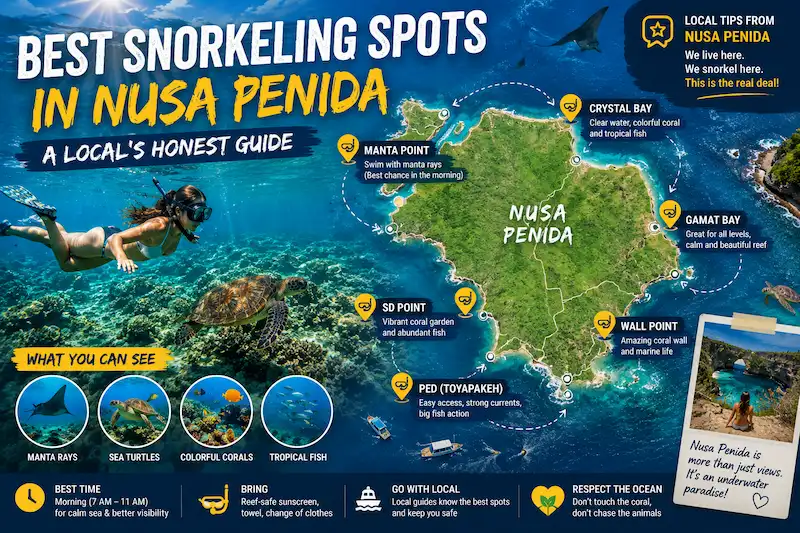 Snorkeling & Diving
June 19, 2026
Best Snorkeling Spots in Nusa Penida: A Local's Honest Guide
Nusa Penida has seven major snorkeling spots, and they are not interchangeable. From the beginner-friendly shallows of Crystal Bay to the 95% manta sighting rate at Manta Point, this honest guide breaks down where to go, what to expect, and which combination actually fits the day you have.
Read more