Best Photo Spots in Nusa Penida: A Local's Honest Guide
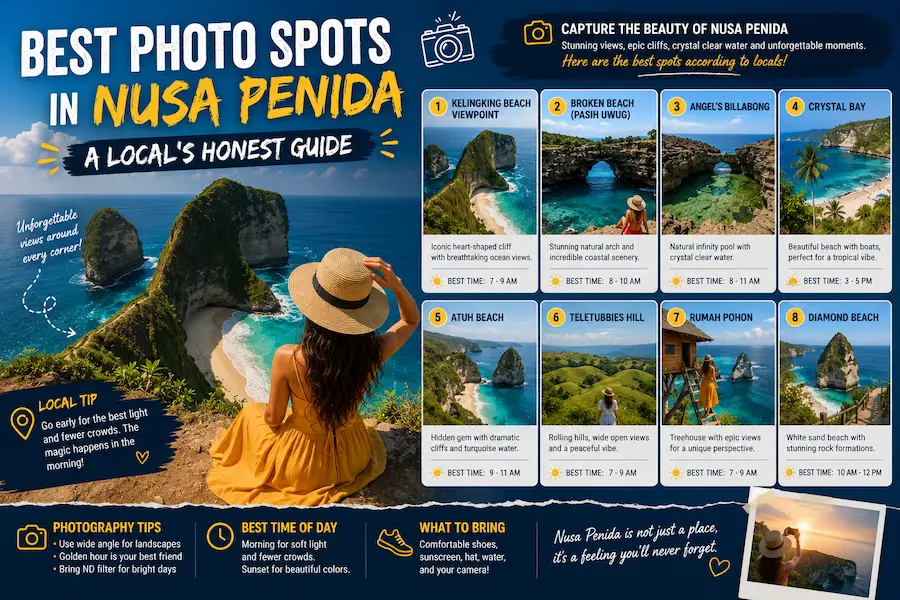
Nusa Penida is one of the most photographed islands in Indonesia, but knowing when to show up and which angle to shoot makes all the difference. This honest guide covers the six most photographed spots on the island — including four distinct angles at Kelingking most visitors never find — written by a local team that watches the light change here every day.
Nusa Penida has become one of the most photographed islands in Indonesia, and for good reason — the cliffs, the colour of the water, the strange rock formations that look almost staged. But knowing when to show up, what to actually expect at each spot, and how the light changes through the day makes the difference between a photo that looks like everyone else's and one that actually captures what the place felt like.
This guide covers the six most photographed spots on the island, written from the perspective of a team that drives these roads and watches the light change at these spots most days of the week.
Kelingking Beach — The T-Rex Cliff
This is the photo most people have already seen before they ever set foot on Nusa Penida — the cliff that curves out into the ocean in a shape that genuinely does resemble a dinosaur's head and neck.
Most visitors only ever see the first viewpoint and assume that's the whole story. There are actually four distinct photo spots along the cliff, each giving a different angle on the same formation — and knowing them in advance means you're not stuck fighting the same crowd at the same single platform.
Spot 1 — The fence, shot from above. Right at the top, by the railing. This is the classic, most-photographed angle, and it's also where you'll find the most people. Our guides will sometimes climb a nearby tree to shoot down at you from a slightly elevated angle, which gives the shot more depth than a straight-on photo from the same level.
Spot 2 — Sitting at the cliff edge. A little further along, still up top, where you sit at the edge of the cliff with the T-Rex formation behind you and the photographer stands to capture it. This angle tends to make the drop and the scale of the cliff feel more dramatic in the final shot.
Spot 3 — Partway down the stairs. A bit further down the staircase that leads toward the beach. The angle here is genuinely good — arguably one of the better ones — but it's also the busiest. Expect to queue, and budget extra patience here more than anywhere else on the cliff.
Spot 4 — The north side, a different angle entirely. Around the other side, where you stand against the cliff face and the photographer climbs up into a tree to shoot down at a different angle than any of the other three spots. This is the one most visitors miss entirely simply because it's further to walk to.
Early morning, roughly 7:30 to 9:00am, gives you softer, angled light across the cliff face without the harsh overexposed sky you get later in the day — and noticeably fewer people fighting for the same few metres of platform at any of these four spots. Late afternoon, closer to golden hour, works well too if mornings aren't realistic for your schedule.
Bring a wide-angle lens or shoot wide on your phone — the cliff is big enough that a standard lens will struggle to fit the whole formation in frame.
→ Full guide: Kelingking Beach Nusa Penida
Diamond Beach — Best at Sunrise
Diamond Beach faces east, which makes it one of the few spots on the island where sunrise genuinely transforms the scene rather than just brightening it. The limestone cliffs catch the early light, and the water has a clarity in the morning that gets harder to capture once the sun is directly overhead.
It's open 24 hours, so there's no entrance schedule to work around — just get there before sunrise if you want the cliffs lit up rather than in shadow. The beach itself is also worth descending to if you have time; the staircase down is steep but the view back up at the cliffs from the sand is a genuinely different photo than the one everyone takes from the top.
→ Full guide: Diamond Beach Nusa Penida
Rumah Pohon Treehouse — Sunrise Is Non-Negotiable Here
If there's one spot on this list where timing actually matters more than anything else, it's the treehouse. The cliffs face east, and the entire appeal of the photo is the golden light hitting the ocean behind the treehouse structure. Arrive after the sun is already up and you're shooting into flat, overexposed light — not the photo you came for.
Plan to arrive 30 to 45 minutes before sunrise to get into position. There's an entrance fee of around IDR 25,000, plus a separate fee of around IDR 75,000 to actually get up on the treehouse platform for photos. It's not a rushed, three-minute-and-out situation — you'll get reasonable time up there without feeling hurried, even if there's a queue.
→ Full guide: Rumah Pohon Treehouse Nusa Penida
Angel's Billabong — Shoot at Mid-Tide
Angel's Billabong is a natural pool carved into the coastline, and the way it photographs changes dramatically with the tide. At mid-tide, the water settles into the layered blues and greens that make this spot famous, and waves break dramatically against the outer rocks without flooding the pool itself.
At high tide or during big swell, skip getting close to the edge entirely — this isn't just a photography note, it's a safety one. Waves here have swept people off the rocks before. Get your shots from a safe distance back, and treat the warning signs around the area as genuinely meant for you, not just decoration.
→ Full guide: Angel's Billabong Nusa Penida
Broken Beach — A View, Not a Beach You Visit
Despite the name, there's no way down to the water at Broken Beach — what you're photographing is the dramatic natural arch and the turquoise water moving beneath it, shot from the clifftop above. Sunrise or sunset light works best here, partly for the colour and partly because the crowds thin out significantly outside midday hours.
The same caution applies here as at Angel's Billabong, which sits just a short walk away: stay back from the edge. This is one of the more dangerous photo spots on the island, and the dramatic drop that makes the photo good is the same drop that's caused serious accidents.
→ Full guide: Broken Beach Nusa Penida
Bukit Teletubbies — Soft Light, Rolling Hills
Named for its resemblance to the rolling green hills from the children's show, Bukit Teletubbies looks completely different depending on the season — vivid green in the wet months, dry and golden-brown for much of the dry season. Neither version is wrong, just know which one you're walking into based on when you visit.
Morning or sunset gives the softest light across the hills; the middle of the day here tends to wash out the gentle colour contrast that makes the landscape interesting, and cloud cover rolls in often during the day. This is also one of the easier spots on the island to fly a drone, if you have one — the open hillside gives a clean, uncluttered aerial shot of the rolling terrain.
→ Full guide: Bukit Teletubbies Nusa Penida
A Few General Tips That Apply Almost Everywhere
Drones are generally welcome. Most of these spots don't restrict drone use, and the aerial perspective genuinely adds something a ground-level shot can't — especially at Kelingking, Bukit Teletubbies, and Diamond Beach. Be considerate of other visitors and keep it reasonable near crowded viewpoints.
Sunrise beats sunset for the east coast spots. Diamond Beach, Rumah Pohon, and the surrounding area all face east, so sunrise is when the light actually works in your favour. Sunset is better suited to the west coast — Kelingking, Broken Beach, Angel's Billabong.
The roads are part of the plan, not an afterthought. Nusa Penida's roads are rough in places, and getting to east coast sunrise spots means leaving in the dark. Plan extra time, and if you're not confident navigating at night on unfamiliar roads, going with a driver who knows the route is worth it just for the sunrise spots alone.
Crowds build fast after 9am almost everywhere. If a quiet, people-free photo matters to you, the difference between arriving at 7am and arriving at 10am is enormous at every spot on this list.
FAQ
What's the single best photo spot in Nusa Penida? Kelingking Beach is the most iconic and most photographed, but Diamond Beach and Rumah Pohon at sunrise are genuinely strong contenders — it depends whether you want the famous shot or a quieter, equally beautiful one.
Are drones allowed in Nusa Penida? Generally yes, at most of the spots on this list, though it's worth checking current local conditions on arrival since rules can shift.
Is sunrise or sunset better for photos? Both work, but on different coasts. East coast spots (Diamond Beach, Rumah Pohon) are built for sunrise. West coast spots (Kelingking, Broken Beach, Angel's Billabong) work well for sunset.
Do I need a professional camera, or is a phone enough? A phone is genuinely enough for every spot on this list — the locations do most of the work. A wide-angle lens or your phone's wide mode helps at Kelingking specifically, where the cliff is hard to fit in frame otherwise.
How early should I arrive for sunrise spots? 30 to 45 minutes before sunrise for Rumah Pohon and Diamond Beach, to get into position before the light starts changing.
Final Thoughts
None of these photos require expensive gear or a professional eye — they require showing up at the right time of day and knowing what to expect once you're there. Time your visits around sunrise or sunset where it matters, stay safe around the cliff edges, and you'll come away with photos worth the early alarm.
For a complete overview of everything else to plan around your trip, see our Nusa Penida Travel Guide.