Cepuk and Rangrang: Nusa Penida's Sacred Weaving Tradition
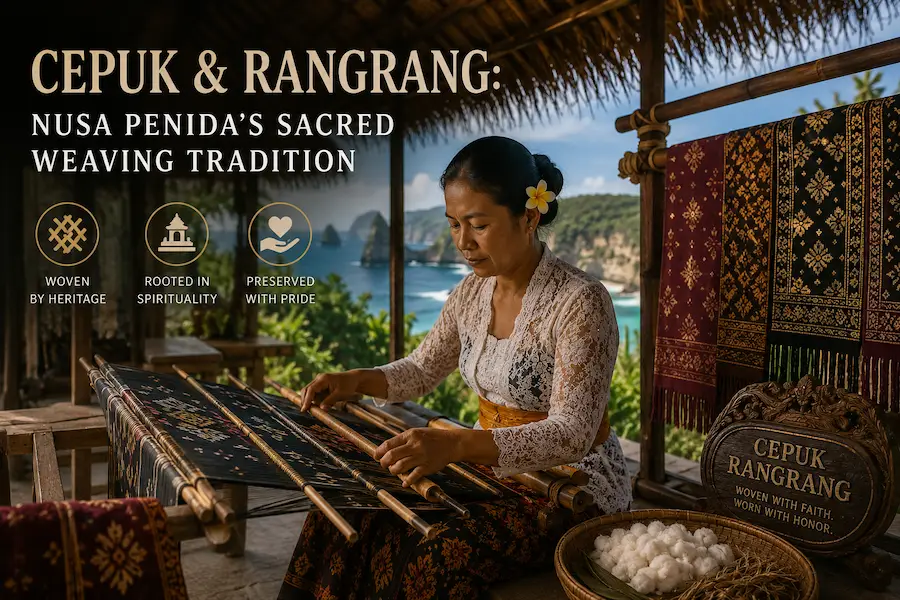
Nusa Penida is known for its cliffs and manta rays. But the island also produces two of the most distinctive hand-woven textiles in Indonesia — Cepuk and Rangrang. Both are sacred fabrics with centuries of history, woven on traditional wooden looms in villages most visitors never reach. This guide tells the full story: where they come from, what makes them different, and where to buy authentic pieces directly from the weavers in Desa Tanglad.
Most visitors to Nusa Penida come for the cliffs and the manta rays. They leave having seen Kelingking Beach, Diamond Beach, and Crystal Bay — and they go home without knowing that the island also produces two of the most distinctive hand-woven textiles in all of Indonesia.
Cepuk and Rangrang are not souvenirs. They are not tourist products. They are sacred fabrics with centuries of history, woven on traditional wooden looms by the same families who have been making them for generations — in villages that most day-trippers never reach.
If you want to understand Nusa Penida beyond its coastline, start here.
Two Fabrics, Two Villages, One Island
Cepuk and Rangrang are often mentioned together, and they share the same island origin. But they are two distinct textiles, produced in two different villages, with different histories, different techniques, and different spiritual significance.
Cepuk comes from Desa Tanglad in the eastern interior of Nusa Penida. Rangrang comes from Desa Pejukutan — specifically Dusun Karang — on the southeastern coast.
Understanding the difference between them is the starting point for appreciating either one.
Kain Cepuk — The Sacred Cloth of Tanglad
What Is Cepuk?
Cepuk is the older and more sacred of the two fabrics. It is classified as kain bebali — a ritual cloth — meaning its original purpose was not decorative or practical but spiritual. For the Hindu community of Nusa Penida, Cepuk has specific ceremonial functions that have remained unchanged for centuries.
The fabric is used at potong gigi (tooth filing ceremonies), ngaben (cremation ceremonies), and other significant Hindu rituals. Certain uses are highly specific: Cepuk serves as the material for kajang — a sacred textile placed on the body during cremation. It is also worn by the Rangda and Celuluk figures in traditional Balinese dance performance. The fabric is believed to carry protective power against negative spiritual forces.
The Meaning of the Name
The word Cepuk has two possible origins. One traces it to Sanskrit, where it refers to kayu canging — a type of wood used as the base material for dyeing the thread. The second interpretation connects it to the Balinese word tepuk, meaning "to meet" — a reference to the diamond-shaped geometric motif at the heart of the fabric, which symbolises the meeting of ilmu penengen (white magic) and ilmu pengiwa (black magic) to create balance between opposing forces in the universe.
Both interpretations carry meaning. The fabric itself embodies balance — between the physical and spiritual, the natural and the sacred.
What Cepuk Looks Like
Cepuk is woven on a traditional wooden loom called a cag-cag. The motifs are geometric and deliberately simple: diamond shapes (wajik), zigzag lines, and rainbow patterns. The fabric has a structured, dense weave with no holes — solid and grounded, reflecting its ceremonial purpose.
The colour palette has traditionally been limited and symbolic. Natural dyes extracted from local plants and trees are used by the most authentic producers — red from mengkudu (morinda) fruit, blue from indigo, brown from mahogany bark. The resulting colours are earthy and deep rather than bright.
A distinctive feature of genuine Cepuk is a series of white thread lines called pangoh taji — one of the most recognisable marks of authentic Nusa Penida weaving.
Where Cepuk Comes From — Desa Tanglad
Tanglad is a village in the interior of eastern Nusa Penida, far from the coastline and the tourist circuit. Weaving has been the economic and cultural backbone of this village for as long as anyone can remember — passed down through generations as both livelihood and spiritual practice.
The exact age of the Cepuk tradition in Tanglad is not precisely known, but oral history places it well before the colonial period. What is certain is that Tanglad has been the centre of Cepuk production on Nusa Penida for generations, and continues to be today.
Kain Rangrang — The Fabric That Almost Disappeared
What Is Rangrang?
Rangrang is the younger sibling of Cepuk in reputation, but equally ancient in origin. Research traces the fabric back to the Majapahit era, where it was known as cerik bolong — the small perforated cloth. Over centuries it evolved through the name nyrangnyang before settling into the word used today: Rangrang.
Like Cepuk, Rangrang was originally a sacred cloth used exclusively for religious ceremonies. Unlike Cepuk, it almost vanished entirely.
By the late 20th century, the knowledge and practice of weaving Rangrang had declined so severely in Nusa Penida that the textile was on the verge of extinction. In 2011, a revival effort centred in Dusun Karang, Desa Pejukutan brought the fabric back into production. Eighty-one weavers in the village were involved in the revival, working to reconstruct and preserve the technique before it was lost permanently.
That revival succeeded. Today Rangrang is not only surviving — it is thriving, sought after by buyers across Indonesia and internationally.
The Meaning of the Name
Rangrang means bolong-bolong in Balinese — full of holes, or perforated. The name is purely descriptive: the defining characteristic of Rangrang fabric is the small open holes that appear at the intersections of the motif pattern throughout the cloth. These gaps are not flaws — they are structural, intentional, and the result of a specific weaving technique that creates the fabric's signature airy quality.
The holes are described as a symbol of transparansi — transparency and openness. The fabric's lightness, both physical and symbolic, is what distinguishes it from the denser Cepuk.
What Rangrang Looks Like
Rangrang is woven on the same cag-cag wooden loom as Cepuk, but the technique produces a completely different result. The fabric is lighter, more open, and more vibrant in colour.
The original colour scheme of Rangrang used only three colours: red, black, and white. These three colours carry deep cosmological meaning — representing life, death, and rebirth in the Balinese Hindu understanding of the cycle of existence. Today's Rangrang production uses a much wider palette, with bright oranges, purples, and blues now common alongside the traditional three. The looser, more open weave structure makes Rangrang well suited to a wider range of uses beyond ceremony — it has become popular as everyday formal wear, fashion fabric, and accessories.
The main motifs are pinggiran gunung (mountain border) along the edges, and central motifs including wajik (diamond), iled, and bianglala (rainbow). A row of white thread lines — pangoh taji — also appears in Rangrang, linking it visually and culturally to Cepuk.
Where Rangrang Comes From — Desa Pejukutan
Pejukutan is on the southeastern coast of Nusa Penida — the same area as Atuh Beach and Diamond Beach. The weaving community is centred in Dusun Karang, where the 2011 revival took place and where most of the island's Rangrang production continues today.
How the Fabrics Are Made
Both Cepuk and Rangrang are produced using the cag-cag — a traditional back-strap loom made entirely from wood, operated by hand without any mechanical or electrical assistance. The weaver sits on the floor with the loom attached to a fixed point, using their body weight and hand movements to control the tension and structure of the weave.
The process begins with preparing the thread, then dyeing it — either with natural plant-based dyes or synthetic alternatives — before the actual weaving begins. Natural dyeing is the more labour-intensive process: different plants, barks, fruits, and roots are used to achieve different colours, and fixatives like calcium carbonate (lime) and potassium alum are used to set the colour permanently.
Natural dye sources used in Nusa Penida weaving include:
- Red and orange: mengkudu (morinda / noni fruit), secang wood
- Blue: tarum (indigofera) leaves
- Brown: mahogany bark, mango bark
- Dark tones: jamblang (java plum) bark
A single piece of fabric can take days or weeks to complete depending on its size, complexity, and whether natural or synthetic dyes are used. The most prized pieces — large, naturally dyed, with complex motifs — can take a skilled weaver a month or more.
Cepuk vs Rangrang — Key Differences
| Cepuk | Rangrang | |
|---|---|---|
| Origin village | Desa Tanglad | Desa Pejukutan (Dusun Karang) |
| Weave structure | Dense, solid — no holes | Open, perforated — characteristic holes |
| Original colours | Earthy, limited palette | Red, black, white — now much wider |
| Ceremonial use | Highly specific ritual functions | Sacred origin, now wider everyday use |
| Texture | Heavy, structured | Lighter, more airy |
| Name meaning | Kayu canging (dye wood) / "to meet" | Bolong-bolong (perforated, full of holes) |
| Near extinction | No | Yes — revived in 2011 |
Where to Buy Authentic Cepuk and Rangrang in Nusa Penida
If you want to buy genuine Cepuk or Rangrang woven directly by local artisans — not machine-made imitations — Desa Tanglad is where to go. Both fabric types are available there, and purchasing directly from the source ensures the money goes to the weaving community rather than intermediaries.
Ngurah Galeri Desa Tanglad, Nusa Penida A family-run gallery selling authentic hand-woven Cepuk and Rangrang directly from local producers. One of the established names for traditional weaving in Tanglad.
Sari Cepuk Woven Fabric Shop Desa Tanglad, Nusa Penida Another reliable source for authentic Cepuk and Rangrang in the same village. Staff can explain the production process and the difference between natural and synthetic dyed pieces.
What to expect on price:
- Selendang (sash/scarf): IDR 100,000 – 250,000
- Standard kain (fabric length): IDR 400,000 – 1,200,000
- Premium naturally-dyed pieces: IDR 1,500,000 – 3,000,000+
Price reflects the time, skill, and materials involved. A naturally-dyed, hand-woven kain that took a weaver several weeks to complete is not the same product as a machine-printed imitation sold at tourist markets. Ask about the dyeing process before you buy — producers who use natural dyes are proud to explain it.
How to Care for Your Cepuk or Rangrang
Hand-woven natural-dyed fabric requires more care than factory-made cloth:
- Hand wash only — cold water, gentle motion. Do not machine wash.
- Do not soak for extended periods — this loosens the dye.
- Do not scrub with a brush — this damages the thread structure.
- Dry in shade — direct sunlight fades natural dyes faster than synthetic ones.
- Do not iron on high heat — use a low setting with a cloth between the iron and the fabric.
FAQ
What is the difference between Cepuk and Rangrang? Both are traditional hand-woven textiles from Nusa Penida, but they are distinct fabrics. Cepuk is from Desa Tanglad — dense, solid weave, deeply sacred, used for specific Hindu ceremonies. Rangrang is from Desa Pejukutan — lighter, open weave with characteristic small holes, originally sacred but now also widely used as everyday formal wear. They are made on the same traditional loom but produce very different results.
Where can I buy authentic Cepuk and Rangrang in Nusa Penida? Both are available at Ngurah Galeri and Sari Cepuk Woven Fabric Shop in Desa Tanglad. Buying directly from these village producers ensures you are getting authentic hand-woven fabric and that the purchase directly supports the local weaving community.
Is Rangrang really full of holes? Yes — the name means exactly that. The open holes at the motif intersections are a structural feature of the weaving technique, not a defect. They give Rangrang its characteristic lightness and are the most reliable visual indicator of authentic hand-woven Rangrang.
Why was Rangrang nearly extinct? By the late 20th century, the practice had declined severely as younger generations moved away from traditional crafts. The 2011 revival in Dusun Karang brought 81 weavers together to reconstruct and preserve the technique before the knowledge was lost permanently.
Can I watch the weaving process? Yes — visiting the weaving galleries in Desa Tanglad often gives you the opportunity to watch weavers at work on the traditional cag-cag loom. This is a genuine craft village, not a performance for tourists.
Are Cepuk and Rangrang still used in ceremonies? Yes. Cepuk in particular retains strong ceremonial significance — it is used in cremation ceremonies, tooth filing rituals, and traditional dance. Rangrang has broader everyday use now but its sacred origins are still respected by the local community.
Final Thoughts
Nusa Penida is known for its coastline. But the island's interior holds a different kind of richness — one measured not in cliff height or water clarity, but in the patience of a weaver working thread through a wooden loom, following patterns that have been passed down through generations.
Cepuk and Rangrang are not easy things to find if you follow the standard tourist route. They are made in villages that most itineraries skip, by communities that have been practising this craft long before anyone photographed the island's beaches.
If you have time in your Nusa Penida itinerary for one stop that most visitors miss — Desa Tanglad and its weaving galleries are worth the detour.
For everything else you need to plan your Nusa Penida trip, visit our Nusa Penida Travel Guide. And if you want to include a visit to Tanglad as part of a private tour, get in touch — we know the island well beyond its famous viewpoints.
Have questions about Cepuk, Rangrang, or local culture in Nusa Penida? Leave a comment below — we answer from direct, on-the-ground experience.
Related Articles
 Food & Culture
June 14, 2026
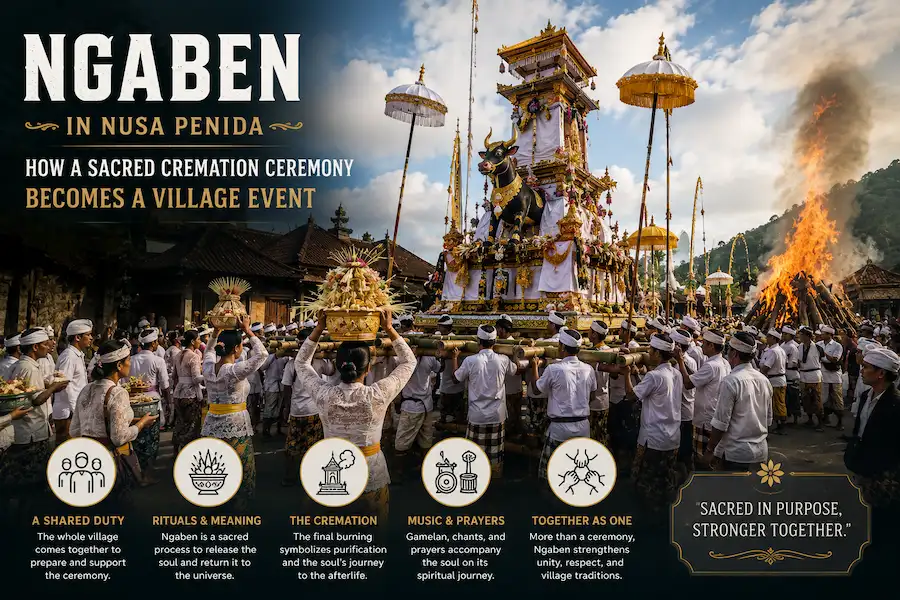
Ngaben in Nusa Penida: How a Sacred Cremation Ceremony Becomes a Village Event
Ngaben in Nusa Penida is not what most visitors expect from a Balinese cremation ceremony. While mainland Bali typically cremates family by family, Nusa Penida has always done it differently — the entire village together, every five years, beneath a single bade rising more than five metres into the air. In coastal villages, the procession moves along the beach rather than through streets. This is what communal devotion looks like when an entire island says goodbye to its people at once.
Read more Travel Guide
June 9, 2026