Ngaben in Nusa Penida: How a Sacred Cremation Ceremony Becomes a Village Event
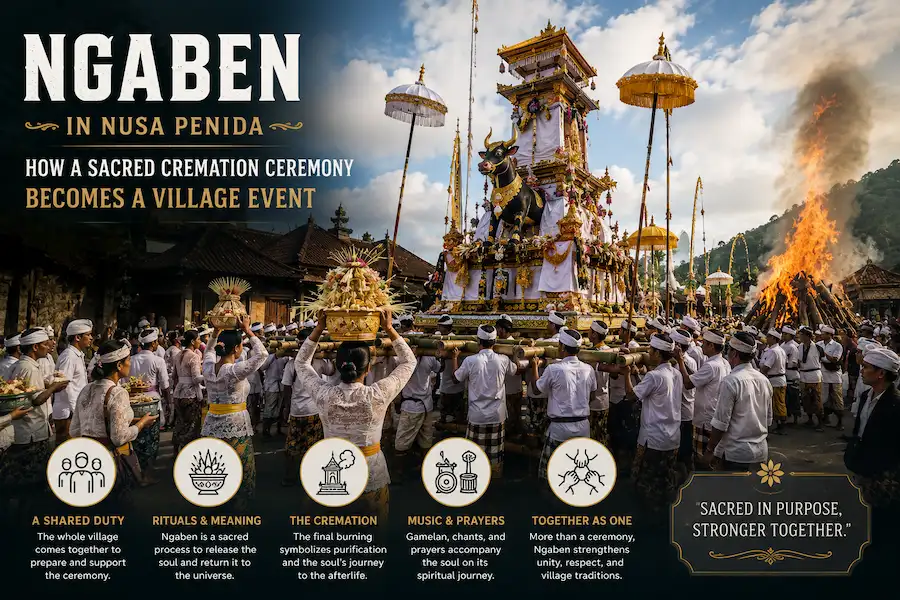
Ngaben in Nusa Penida is not what most visitors expect from a Balinese cremation ceremony. While mainland Bali typically cremates family by family, Nusa Penida has always done it differently — the entire village together, every five years, beneath a single bade rising more than five metres into the air. In coastal villages, the procession moves along the beach rather than through streets. This is what communal devotion looks like when an entire island says goodbye to its people at once.
If you have spent time in Bali, you may have encountered a ngaben — the Hindu cremation ceremony that transforms death into a community celebration. The sound of gamelan, the procession through the streets, the ornate tower carried by dozens of people. It is one of the most moving things you can witness in Bali.
Ngaben in Nusa Penida is all of that — and something else entirely.
On the mainland, most families cremate their deceased individually. The ceremony is a family event, the tower modest in size, the procession contained to one household's resources and network. In Nusa Penida, ngaben is different by both tradition and necessity. Here, the entire village cremates together — sometimes fifty, sixty, or more souls at once — beneath a single towering bade that rises more than five metres into the air and requires the strength of hundreds of hands to carry.
And in the villages that sit along the coast, the procession does not move through streets. It moves along the beach.
What Is Ngaben?
Ngaben is the Balinese Hindu cremation ceremony — one of the most important rituals in the Hindu calendar. Its purpose is to release the soul (atma) from the physical body so it can continue its journey toward reincarnation or, ultimately, union with the divine.
In Balinese Hindu belief, the physical body is a temporary vessel made of five elements — earth, water, fire, wind, and space. At death, these elements must be returned to their origins through cremation. The ngaben ceremony performs this return, guided by priests and accompanied by offerings, prayers, and the participation of the entire community.
Despite involving death, ngaben is not a mournful occasion in the Western sense. It is understood as a liberation — the soul freed from the limitations of the physical world, released to continue its spiritual journey. Families and communities approach ngaben with a spirit of devotion, gotong royong (communal cooperation), and even joy.
Ngaben in Bali vs Ngaben in Nusa Penida
This is where Nusa Penida diverges from the mainland — and the difference is significant.
On mainland Bali, ngaben is typically performed by individual families. Each family handles the cremation of their own deceased, in their own time, with a ceremony scaled to their means. The bade — the ornate multi-tiered cremation tower — is built according to the family's caste and financial capacity. For most families, this means a relatively modest structure. Only the families of royal lineage (triwangsa) build the grand, towering bades that reach many storeys high and require large processions to carry.
In Nusa Penida, almost every village practices ngaben massal — mass cremation. Multiple families across the village combine their deceased into a single ceremony, sharing the costs, the labour, and the spiritual weight of the ritual. This is not a compromise or a shortcut — it is the traditional way ngaben has always been performed on this island, rooted in both cultural practice and practical reality.
The reasons are two-fold:
Tradition: Mass ngaben is the ancestral custom in Nusa Penida. The communal nature of the ceremony reflects the island's deep culture of gotong royong — the principle that major events in life are the responsibility of the whole community, not just the individual family.
Cost: A full ngaben ceremony is extraordinarily expensive. The offerings, the priests, the bade construction, the materials, the food for hundreds of guests — the total cost for a single family ceremony can reach tens of millions of rupiah. By combining into a mass ceremony held every five years, villages share these costs across many families, making the ceremony more accessible to everyone regardless of individual wealth.
The Bade — A Tower That Takes a Village to Carry
The most visually striking element of ngaben in Nusa Penida is the bade.
In village ngaben massal on the island, the bade rises more than five metres into the air — a towering, elaborately decorated structure built from bamboo, wood, and ornamental materials. It is carried not by a small group but by a large coordinated crowd of villagers, moving in rhythm, guided by those at the front and sides. The number of people required to carry a bade this size is substantial — this is communal effort made visible.
The bade is built with multiple tiers, each decorated with intricate carvings, coloured cloth, and offerings. The number of tiers traditionally reflects the caste and spiritual status of the deceased. In a mass ngaben, all participants are carried together in the same bade, their status unified in a shared journey.
Watching a bade of this scale being carried through a village — or along a beach — by hundreds of people moving as one, to the sound of gamelan and baleganjur percussion, is one of the most extraordinary things you can witness in Indonesia.
The Coastal Procession — Unique to Nusa Penida's Beach Villages
For villages situated along Nusa Penida's coastline, the ngaben procession takes on an additional dimension that you will not find anywhere else in Bali.
Instead of moving the bade through narrow village roads, coastal communities carry it along the beach — the wide expanse of sand providing the space that the road cannot. The procession moves along the shoreline, the towering bade swaying above the crowd, the ocean as backdrop, the gamelan carrying across the water.
This is not a modern adaptation. It is a response to geography that has been practiced for generations — the beach serving as the village's ceremonial ground when the road is too narrow for a structure of this scale and the number of people needed to carry it.
For visitors who happen to witness a coastal ngaben procession in Nusa Penida, it is almost impossible to describe the effect. The scale of the bade, the size of the crowd, the sound of the music against the open sea — it is a collision of the sacred and the elemental that stays with you.
Every Five Years — The Rhythm of the Village
Ngaben massal in Nusa Penida is not held whenever a family is ready. It is held according to a cycle — approximately every five years per village, on an auspicious date determined by the Balinese Hindu calendar (duase) in consultation with priests.
This cycle has practical and spiritual dimensions.
Practically, it means that families who lose a loved one may wait — sometimes years — before the official village ceremony. During this waiting period, the body may be buried temporarily in a process called nyekah or ngeringkes, with the remains exhumed and prepared when the mass ceremony date arrives. This requires trust in the community and acceptance of the timeline that the village collectively observes.
Spiritually, the five-year cycle creates a shared moment of collective remembrance and release. An entire generation of souls — those who have passed since the last ceremony — are sent forward together. The village pauses as a whole to acknowledge those it has lost and perform the sacred duties it owes them.
The scale of these ceremonies reflects this accumulation: a single ngaben massal in Nusa Penida may involve 40, 50, 60 or more sawa (deceased) at once, representing years of loss across multiple families and banjar within the village.
The Procession: What Happens During Ngaben Massal
The ceremony unfolds over several days of preparation and ritual before the main procession and cremation:
Ritual preparation days: Priests perform the preliminary ceremonies — the melaspas kajang (consecration of the sacred cloth), the mapeed (ritual procession of offerings), and the ngeringkes (gathering and preparation of remains).
The main procession day: The bade is constructed and decorated in the days before. On the appointed day, village members gather — the men to carry the bade, the women to carry the offerings, the priests to lead the prayers. The procession moves through the village (or along the beach, in coastal communities) to the cremation site (setra), accompanied by gamelan and baleganjur.
The cremation: At the setra, priests perform the final blessings and prayers. The bodies are cremated together. For some coastal villages, elements of the ceremony extend to the water's edge.
The completion: After cremation, the ashes are taken to the sea — the final element of the return, releasing the last physical remnants of the body to the ocean.
For Visitors: How to Witness Ngaben Respectfully
Ngaben massal in Nusa Penida is a public ceremony, and visitors are welcome to observe and photograph it. The community understands that outsiders are drawn to the ceremony, and in many villages, the presence of respectful observers is considered positive — a recognition of the significance of the event.
That said, attending requires awareness and respect:
Dress appropriately. You do not need full ceremonial dress, but covered shoulders, long pants or a sarong, and modest clothing are expected. Do not arrive in swimwear or beach clothes.
Be quiet and respectful during prayers. The ceremony has moments of intense spiritual focus — when priests are chanting and offerings are being made, step back, lower your camera, and observe in silence.
Ask before photographing individuals up close. Photographing the procession and the bade from a respectful distance is generally fine. Taking close-up photographs of grieving family members without permission is not.
Do not obstruct the procession. The bade and the crowd carrying it need clear space to move. Stay to the sides, not in front.
Follow local cues. Watch how local observers behave and mirror that. If people are moving back, move back. If people are quiet, be quiet.
Never touch the bade or the ceremonial objects. These are sacred.
When and Where to Find Ngaben Massal in Nusa Penida
Because each village holds its ceremony on its own five-year cycle, there is no single fixed date for all of Nusa Penida. Multiple villages may hold ngaben massal in the same year, or the ceremonies may be spread across different years.
If witnessing a mass ngaben is something you specifically want to experience during your trip, the best approach is to ask locally — our team at Melali Nusa Penida can let you know whether any village ceremony is coming up during your visit. Timing is everything: some of the most spectacular ceremonies — particularly in coastal villages — are genuinely once-in-five-years events.
FAQ
Is ngaben in Nusa Penida different from ngaben in Bali? Yes, significantly. The main differences are that Nusa Penida practices mass ngaben — multiple families cremating together — while mainland Bali typically performs individual family ceremonies. The bade in Nusa Penida mass ngaben also tends to be larger and taller, requiring the entire village to carry it. In coastal villages, the procession moves along the beach rather than through streets.
Why do villages in Nusa Penida do mass ngaben? Two reasons: tradition and cost. Mass ngaben is the ancestral custom in Nusa Penida, rooted in the island's culture of communal cooperation. It also makes the ceremony financially accessible — the enormous cost of a full ngaben is shared across many families rather than borne by one.
How often is ngaben massal held in Nusa Penida? Approximately every five years per village, on an auspicious date determined by the Balinese Hindu calendar in consultation with priests.
Can tourists attend and photograph ngaben in Nusa Penida? Yes — mass ngaben in Nusa Penida is a public ceremony and visitors are welcome to observe and photograph it respectfully. Dress modestly, stay out of the way of the procession, and follow the lead of local observers.
Why do some coastal villages carry the bade along the beach? Because the beach provides more space than the narrow village roads for a bade of this scale and the hundreds of people needed to carry it. It is a practical adaptation to coastal geography that has become its own distinct tradition.
How big is the bade in Nusa Penida ngaben massal? More than five metres tall — significantly larger than the bades used in individual family ngaben ceremonies on the mainland, which are typically much smaller. Only royal family ceremonies on mainland Bali produce comparable scale.
Final Thoughts
There are many things that make Nusa Penida different from mainland Bali. The cliffs are different. The roads are different. The pace is different.
And the way the island says goodbye to its people is different too.
A mass ngaben in Nusa Penida — fifty souls carried together in a five-metre tower, the whole village moving as one, the beach as the procession ground and the ocean as the final destination — is one of the most profound expressions of community you will encounter anywhere in Indonesia.
If you have the chance to witness it, do. Dress properly, stay respectful, and let yourself be moved by it.
For a complete guide to Nusa Penida's culture, landscapes, and experiences, visit our Nusa Penida Travel Guide. To plan a visit that goes beyond the standard tour circuit, get in touch — we know this island in all its depth.
Have questions about ngaben or other cultural traditions in Nusa Penida? Leave a comment below — we answer from direct, on-the-ground experience.
Related Articles
 Food & Culture
June 14, 2026
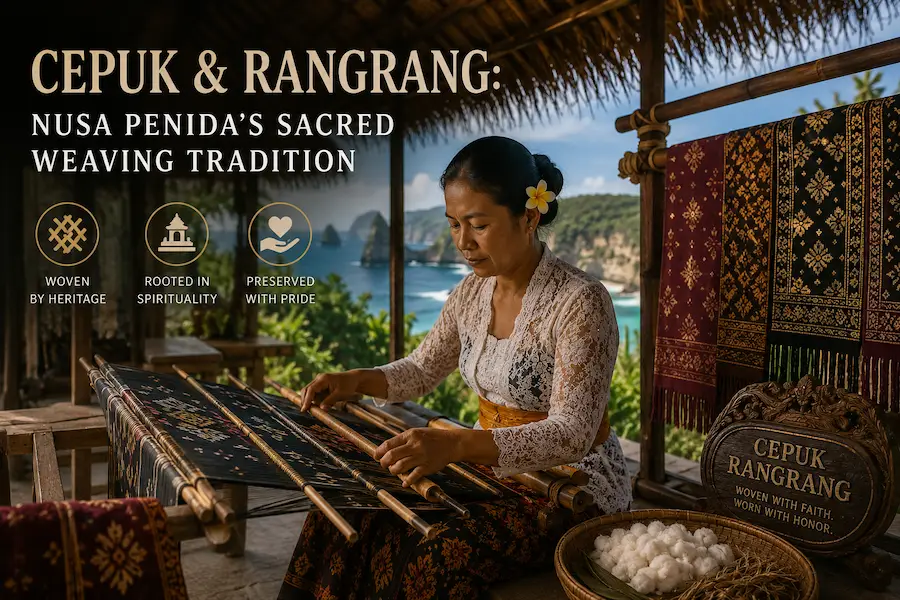
Cepuk and Rangrang: Nusa Penida's Sacred Weaving Tradition
Nusa Penida is known for its cliffs and manta rays. But the island also produces two of the most distinctive hand-woven textiles in Indonesia — Cepuk and Rangrang. Both are sacred fabrics with centuries of history, woven on traditional wooden looms in villages most visitors never reach. This guide tells the full story: where they come from, what makes them different, and where to buy authentic pieces directly from the weavers in Desa Tanglad.
Read more Travel Guide
June 9, 2026